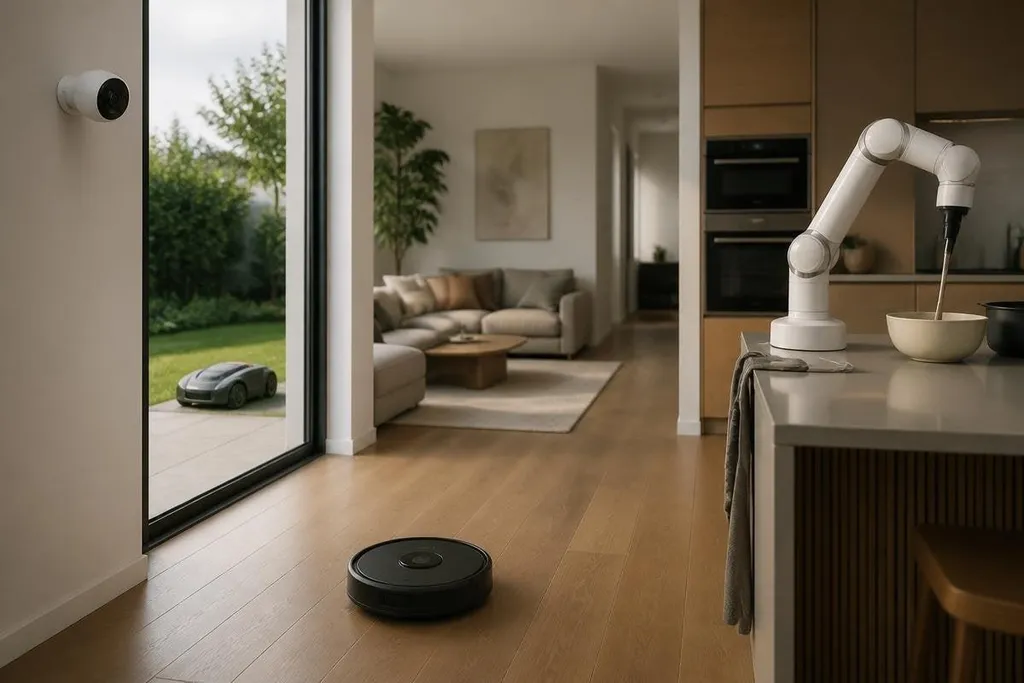
A single AI could, in theory, control a robot vacuum, lawn mower, camera, and kitchen arm. The hard part is giving those machines a common way to describe rooms, tasks, safety limits, and failures.
A home system also needs to know when one robot should stop so another can move. The real question is how those machines would share control rules.
Quick read
- One AI could plan tasks while separate robot software handles movement.
- Shared maps and device rules would matter more than a single brand of hardware.
- Safety, privacy, and poor network access would limit any whole-home system.
What one home AI would control
A useful setup would split the work into layers. The AI would receive a request such as “clean the kitchen before dinner,” break that request into steps, and send each robot a task it can perform.
The robot vacuum could map the floor and report blocked areas. A smart camera could check whether people are in the room. A robotic arm, if the home had one, could move objects from a safe work area. Each machine would still need its own software for motors, sensors, and emergency stops.
That split matters because a general AI is poor at handling every motor command directly. A small error in a sentence is easy to fix. A small error in a wheel speed, arm angle, or cutting tool can damage property or hurt someone.
The shared AI would work better as a planner. Each robot would remain responsible for the actions it can perform safely.
The missing shared language
Home robots come with different sensors, maps, charging systems, and task rules. One robot may describe a room by name, while another stores a grid of free and blocked floor space. A system that joins them needs a translation layer.
That layer would need to answer plain questions:
- Which rooms can the robot enter?
- What objects may it move?
- Where can it charge?
- What should happen when a person enters?
- Which tasks need approval before they start?
The answers would need to stay current. A chair moved across the room can change a floor map. A closed door can block a route. A child or pet can turn an ordinary task into a safety problem.
A shared AI would need to read maps, camera feeds, battery levels, and safety stops from different robots. A report from Robot 24 can name the systems and tests behind those claims, before the next section separates shared planning from robot-specific control.
Why one model cannot do everything
A home AI would need access to data from every connected machine. That raises a privacy question before the system does any useful work. Cameras, microphones, maps, and task history can show when people are home and how they use each room.
Network access creates another limit. If the system needs a remote server for every decision, a weak connection can delay a task or stop it. A safer design would keep urgent control on the robot and use the shared AI for planning when the network is available.
Different makers would also set different rules. A vacuum maker may allow room maps but block outside control. A robot arm may require a person to approve each action near a work surface. One AI can send requests, but it cannot erase those limits.
The system would also need a record of why it chose an action. If two robots reach a narrow hallway, you should be able to see which task had priority and why the other robot stopped.
A shared planner makes sense for simple jobs that cross device boundaries. It could ask the vacuum to clear a floor before a mobile robot carries an object through the room.
It could send a mower to its dock when rain is detected by a home sensor, if the system has access to that sensor and the mower accepts the command. Those tasks still depend on accurate maps and clear permissions.
The AI cannot make a robot lift an object when the gripper has no safe way to hold it. It also cannot make a vacuum cross a step it cannot climb.
I'd trust one AI to plan household tasks before I'd trust it to control every motor in the house.
A practical test for buyers
Before buying into a whole-home robot system, check these points:
- Local control: Confirm that emergency stops and basic movement work without a remote server.
- Device access: Check which commands each robot accepts from outside software.
- Map sharing: Find out whether room maps stay in the home or leave it.
- Human approval: Set approval rules for doors, stairs, tools, and moving objects.
- Failure handling: Test what happens after a blocked route, lost connection, or low battery.
The next useful step is a shared home control layer with strict limits, clear logs, and local safety controls. A single AI may plan the work, but every robot still needs permission to refuse a task it cannot perform safely.